Pathways Resource Library
Tools to help people understand their options
Explore messaging, research, and resources from across the field—along with customizable, white-label tools that you can adapt, brand as your own, and use in your organization’s communications—to help you reach key audiences with language that builds confidence and expands what’s possible.
Research Report
Voices of Gen Z
This resource may be shared with proper attribution to the organization.
This resource may be shared with proper attribution to the organization.
To better understand Gen Z’s unique perspectives, Gallup and the Walton Family Foundation have partnered to gather opinions directly from members of Gen Z and to track those opinions and experiences over time. This nationally representative, multiyear study of thousands of members of Gen Z between the ages of 12 and 26 gives policymakers and researchers an invaluable resource for not only understanding this generation’s needs, but for making data-driven decisions to address them.
Research Report
Unlocking Economic Prosperity
This resource may be shared with proper attribution to the organization.
This resource may be shared with proper attribution to the organization.
Toolkit
Credit for Prior Learning Messaging Toolkit
This resource may be shared with proper attribution to the organization.
This resource may be shared with proper attribution to the organization.
This toolkit provides effective messages targeted to key audiences and strategies for dissemination to increase participation in Credit for Prior Learning among adult learners who are pursuing career pathways and CTE programs of study that lead to jobs in in-demand fields.
Research Report
Pathways Matter to Families: What Parents and Young Adults Believe and Want to Know About Education to Workforce Pathways
This resource may be shared with proper attribution to the organization.
This resource may be shared with proper attribution to the organization.
Pathways Matter to Families offers insights and actionable resources for students and families. The two complementary resources linked are informed by original research investigating what parents and young adults think and want to know about education-to-workforce pathways and experiences.
Article
What it will take to change the narrative about career education
This resource may be shared with proper attribution to the organization.
This resource may be shared with proper attribution to the organization.
The article discusses the growing issue of young Americans aged 18-24 not engaging in college or work, exacerbated by the pandemic. Despite high job vacancies, there's skepticism toward non-college education and job-training programs. The article highlights policy recommendations to integrate workforce training and higher education, stressing that both traditional and non-degree credentials are essential for economic mobility. The purpose is to advocate for a broader, more inclusive approach to postsecondary education and workforce training, aiming to enhance economic opportunities for all.
Book
Choosing College
This resource may be shared with proper attribution to the organization.
This resource may be shared with proper attribution to the organization.
This report looks at how people make decisions regarding higher education through “Jobs-to-be-Done” theory which interrogates and exposes the real reasons people make personal choices, from buying a milk shake to make life-changing decisions. The analysis based on this theory, provides important insights, both for college-bound students and their families, but also institutions of higher education, many of which might be tooling themselves to perform the wrong job.
White Paper
Degrees of Risk: What Gen Z and Employers Think About Education-to-Career Pathways… and How Those Views are Changing
This resource may be shared with proper attribution to the organization.
This resource may be shared with proper attribution to the organization.
This is an examination of what is required to make a person employable, as well as what professional and educational success looks like. This study was commissioned by American Student Assistance (ASA) and Jobs for the Future (JFF). The research aimed to understand current familiarity with and perceptions of non-degree postsecondary pathways from both Gen Z and employer perspectives. This paper also makes recommendations for the way forward to expand high-quality postsecondary options for all learners.
Research Report
The Features of Narratives: A Model of Narrative Form for Social Change Efforts
This resource may be shared with proper attribution to the organization.
This resource may be shared with proper attribution to the organization.
Calls for narrative change abound in social change work. But what kinds of patterns qualify as narratives, and how narratives are embedded within particular stories, remains hazy. This report introduces a model of narrative, defining the elements and identifying the patterns in stories that comprise the narrative form. Our model identifies a set of features that make up a narrative, offering a practical tool for those working to change narratives within and beyond the issue of poverty.
White Paper
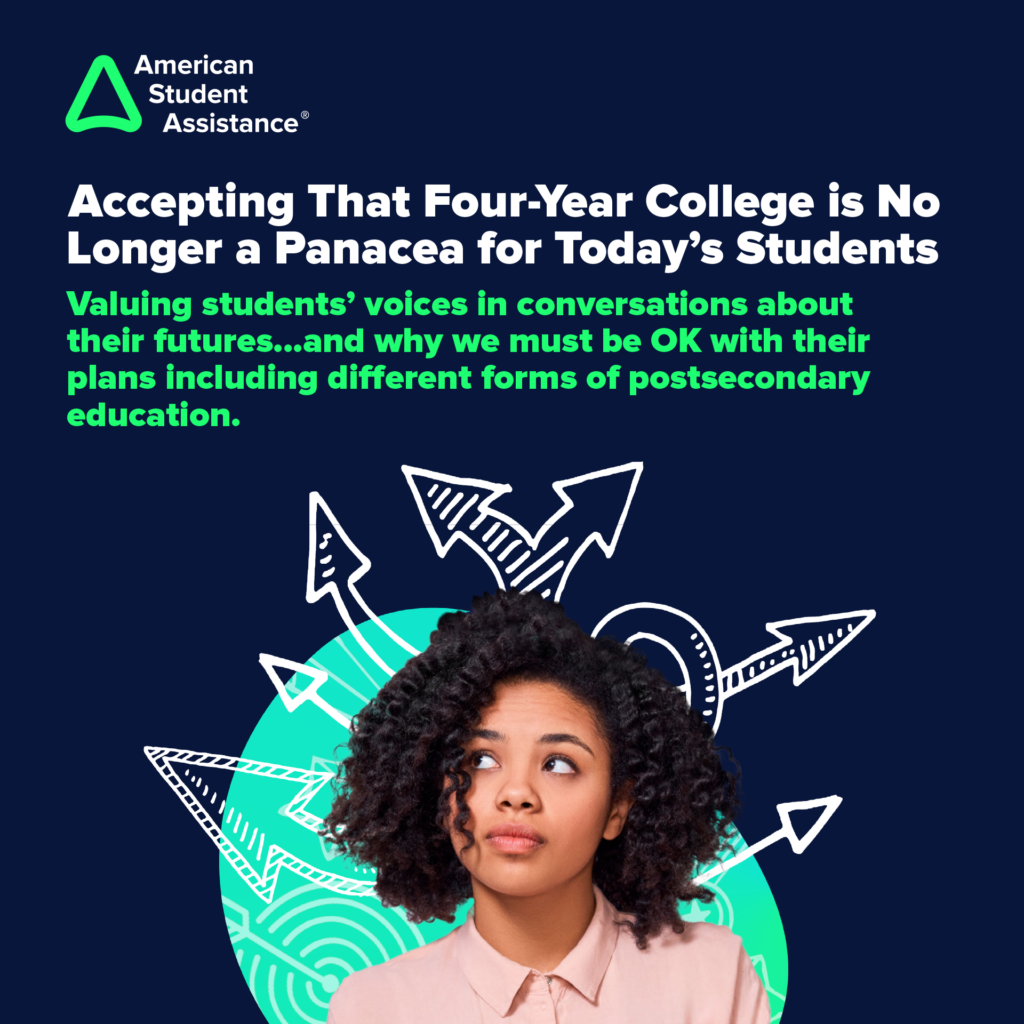
Accepting that Four Year College is No Longer a Pancea
This resource may be shared with proper attribution to the organization.
This resource may be shared with proper attribution to the organization.
This whitepaper resource by the American Student Assistance explains the importance of valuing students’ voices in conversations about their futures, and why families and communities must be OK with their plans including different forms of postsecondary education. Coverage includes the contextual differences of the college landscape "then vs. now", the pressures of decisionmaking and college attendence, policy recommendation, college students' aspirations, and how to guide them in times of uncertainty.
Filters
Research Report
Voices of Gen Z
This resource may be shared with proper attribution to the organization.
This resource may be shared with proper attribution to the organization.
To better understand Gen Z’s unique perspectives, Gallup and the Walton Family Foundation have partnered to gather opinions directly from members of Gen Z and to track those opinions and experiences over time. This nationally representative, multiyear study of thousands of members of Gen Z between the ages of 12 and 26 gives policymakers and researchers an invaluable resource for not only understanding this generation’s needs, but for making data-driven decisions to address them.
Research Report
Unlocking Economic Prosperity
This resource may be shared with proper attribution to the organization.
This resource may be shared with proper attribution to the organization.
Toolkit
Credit for Prior Learning Messaging Toolkit
This resource may be shared with proper attribution to the organization.
This resource may be shared with proper attribution to the organization.
This toolkit provides effective messages targeted to key audiences and strategies for dissemination to increase participation in Credit for Prior Learning among adult learners who are pursuing career pathways and CTE programs of study that lead to jobs in in-demand fields.
Research Report
Pathways Matter to Families: What Parents and Young Adults Believe and Want to Know About Education to Workforce Pathways
This resource may be shared with proper attribution to the organization.
This resource may be shared with proper attribution to the organization.
Pathways Matter to Families offers insights and actionable resources for students and families. The two complementary resources linked are informed by original research investigating what parents and young adults think and want to know about education-to-workforce pathways and experiences.
Article
What it will take to change the narrative about career education
This resource may be shared with proper attribution to the organization.
This resource may be shared with proper attribution to the organization.
The article discusses the growing issue of young Americans aged 18-24 not engaging in college or work, exacerbated by the pandemic. Despite high job vacancies, there's skepticism toward non-college education and job-training programs. The article highlights policy recommendations to integrate workforce training and higher education, stressing that both traditional and non-degree credentials are essential for economic mobility. The purpose is to advocate for a broader, more inclusive approach to postsecondary education and workforce training, aiming to enhance economic opportunities for all.
Book
Choosing College
This resource may be shared with proper attribution to the organization.
This resource may be shared with proper attribution to the organization.
This report looks at how people make decisions regarding higher education through “Jobs-to-be-Done” theory which interrogates and exposes the real reasons people make personal choices, from buying a milk shake to make life-changing decisions. The analysis based on this theory, provides important insights, both for college-bound students and their families, but also institutions of higher education, many of which might be tooling themselves to perform the wrong job.
White Paper
Degrees of Risk: What Gen Z and Employers Think About Education-to-Career Pathways… and How Those Views are Changing
This resource may be shared with proper attribution to the organization.
This resource may be shared with proper attribution to the organization.
This is an examination of what is required to make a person employable, as well as what professional and educational success looks like. This study was commissioned by American Student Assistance (ASA) and Jobs for the Future (JFF). The research aimed to understand current familiarity with and perceptions of non-degree postsecondary pathways from both Gen Z and employer perspectives. This paper also makes recommendations for the way forward to expand high-quality postsecondary options for all learners.
Research Report
The Features of Narratives: A Model of Narrative Form for Social Change Efforts
This resource may be shared with proper attribution to the organization.
This resource may be shared with proper attribution to the organization.
Calls for narrative change abound in social change work. But what kinds of patterns qualify as narratives, and how narratives are embedded within particular stories, remains hazy. This report introduces a model of narrative, defining the elements and identifying the patterns in stories that comprise the narrative form. Our model identifies a set of features that make up a narrative, offering a practical tool for those working to change narratives within and beyond the issue of poverty.
White Paper
Accepting that Four Year College is No Longer a Pancea
This resource may be shared with proper attribution to the organization.
This resource may be shared with proper attribution to the organization.
This whitepaper resource by the American Student Assistance explains the importance of valuing students’ voices in conversations about their futures, and why families and communities must be OK with their plans including different forms of postsecondary education. Coverage includes the contextual differences of the college landscape "then vs. now", the pressures of decisionmaking and college attendence, policy recommendation, college students' aspirations, and how to guide them in times of uncertainty.